
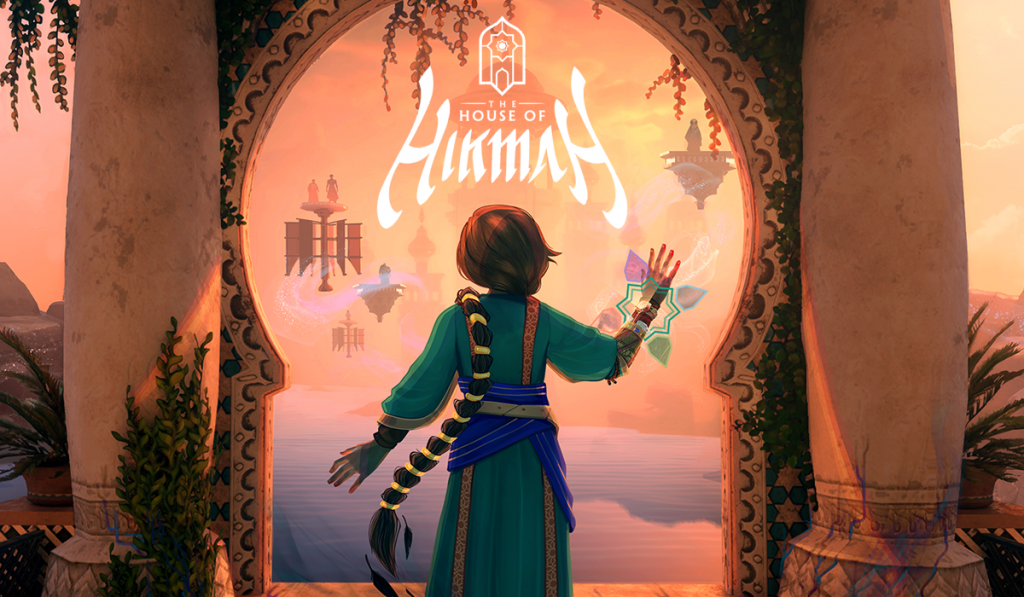
Have you ever played a video game inspired by the golden age of Arabic scientific and cultural development? Would you like to?
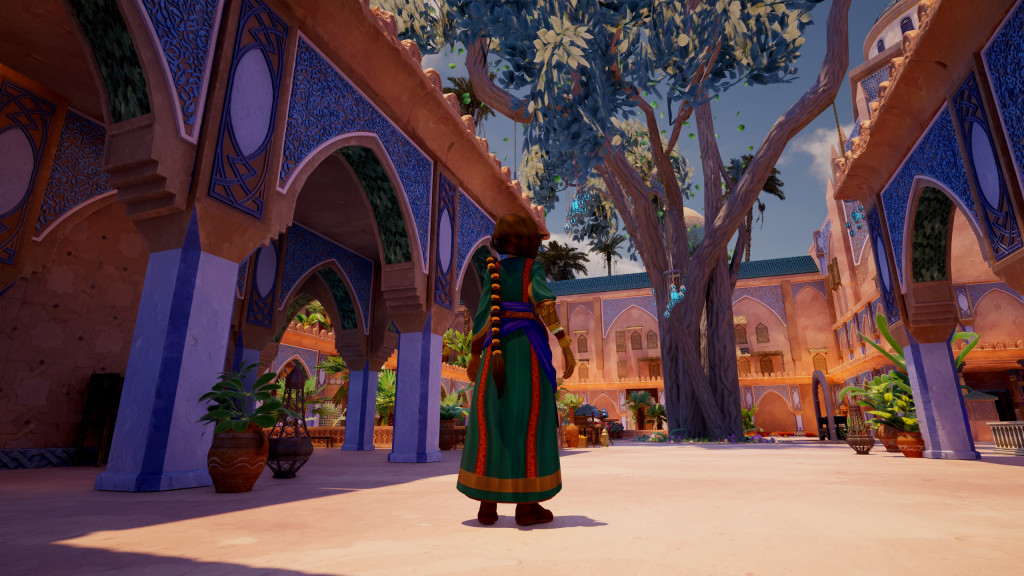
The House of Hikmah is a 3D puzzle-platformer developed and published by Lunacy Studios, in their grand debut. Lunacy is an interesting studio: an independent, fully-remote, junior-built team dedicated to making diverse, narrative-heavy stories. Will Lunacy’s ethically-sourced games nudge out a healthy space in a crowded market that can’t even support Fortnite? Well, based on the experience I, a pasty white boy who is most certainly not part of the target audience, had with it, I believe they can. The House of Hikmah is a short, comfortable, well-crafted experience, like drinking a bowl of homemade soup. But what makes it so satisfying?
The Key To Success – Narrative
I’ll start with the story, since it’s so central to The House of Hikmah as a whole. You play as Maya, a 14-year-old Arabic girl living in some unstated time. Her father, Abdullah, is a scholar for the eponymous House, a magical school that connects master scientists and craftsmen across time and space. They collaborate amongst each other to uncover the mysteries of both the natural world and the Astral Plane that connects the House together. Tragically, Abdullah dies in a shipwreck sometime before the game starts, and leaves Maya a mystical Key. Maya is invited by the scholars to visit the House in his stead, to learn how the Key works and how to use it.
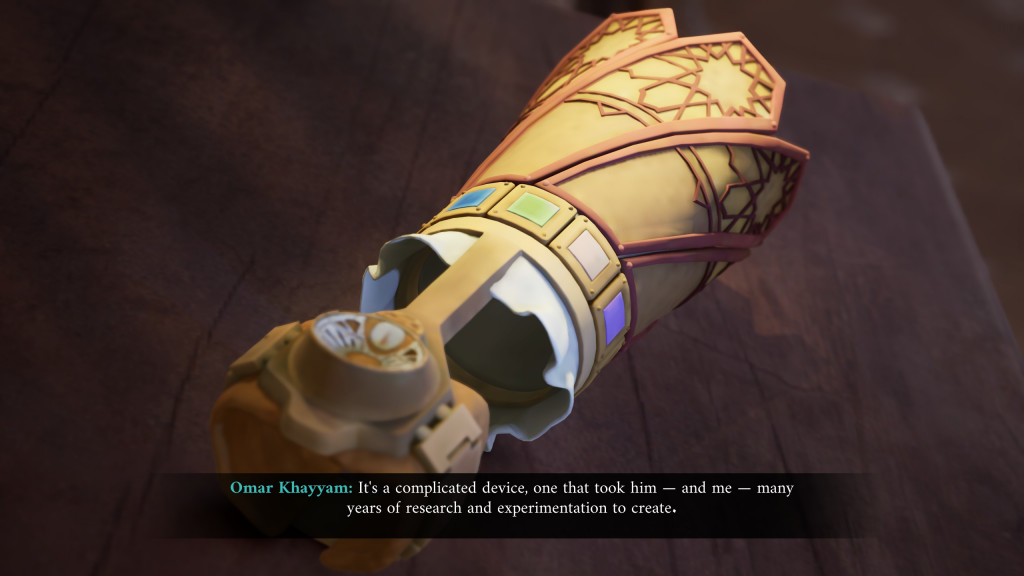
At its core, The House of Hikmah is a story about loss, grief, and how to deal with it. Everyone in the House feels Abdullah’s absence, especially Maya, and the story revolves around coming to terms with those feelings. This soul-crushing grief is represented by The Shadow, an antagonistic force that has infested the house. It whispers your own darkest thoughts back at you, driving you mad with shame; and there’s certainly a lot of shame in the house over Abdullah’s passing, and what could have been. Maya’s goals soon shift from learning about the Key to using it to stop the Shadow, save the House, and come to terms with her own grief in the process.
Characters
If you’ve ever read a young adult novel, this story follows similar beats. Maya is the classic YA protagonist: young, headstrong, independent, and wary of people who tell her what to do. And, like most YA protagonists, Maya makes a lot of risky and downright stupid decisions as the plot goes on. But thankfully, the writers ensure that Maya is not rewarded for her mistakes and learns important lessons from them. She certainly isn’t a Mary Sue, either; she doesn’t know everything, and she has to rely on help from others to become a better person, even as she helps those around her in the process. The story’s strength hinges on if you connect with Maya, and while I personally found some of her decisions a little cliche, I couldn’t help but root for her.
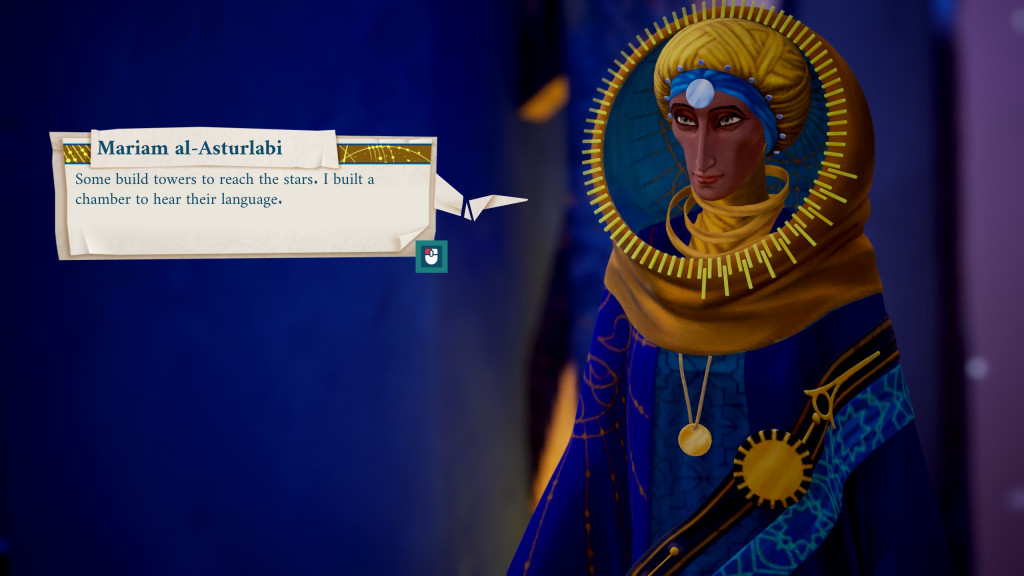
Maya’s surrounded by a supporting cast of scholars, who for the most part are all based on real Arabic scientists and artists. Each one has their own distinct personality and relationship with Maya, which develops as you progress through their levels. Each level is a personification of its scholar, from the gigantic astrolabe of Mariam al-Asturlabi to the floating mechanarium of Ismail al-Jazari. As you solve puzzles and leap over pits, you learn more about each scholar and their relationship with Abdullah, and how they cope with his loss. Despite their idiosyncracies, I found the scholars endearing, and I came to care about saving their work and the House.
Oh, and there’s an owl. You can pet the owl.
Gameplay
At its core, The House of Hikmah is a puzzle platformer. There are no enemies, there is no combat, and any slip off the map respawns you no worse for wear. The focus is entirely on progressing through levels by solving puzzles and jumping across a whole lot of floating platforms. And the way you solve these puzzles is through your Key.
The Key is the focal point of the game, both in narrative and in gameplay. As every loading screen takes care to remind you, the Key allows Maya to change the properties of mystical objects. You’ll use it to turn ghostly detritus into platforms, shift clay into magnetic metal, and redirect light through glass. The game does a great job of introducing new mechanics and using them to their fullest potential. I had plenty of “aha” moments where I realized exactly what I needed to do to progress. That’s the hallmark of a good puzzle game. I also had a lot of moments where I slapped myself on the head for not trying the simplest possible solution, which is also the hallmark of a good puzzle game.
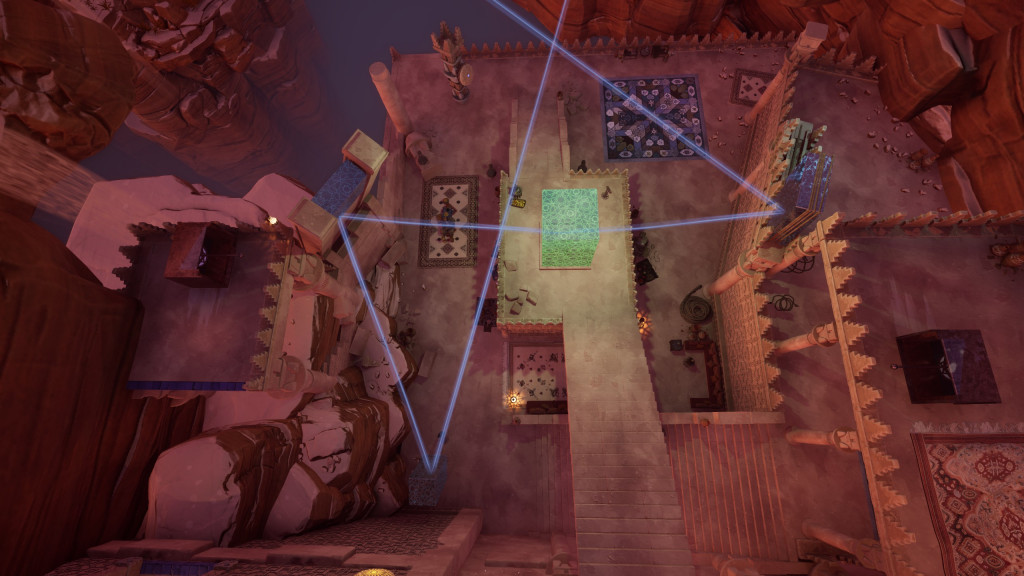
The platforming is decent, if not complex. It’s primarily a way to break the pacing between puzzles, since there are really no consequences for missing a jump. I found Maya very floaty at first, but I got used to it pretty quickly. This isn’t a game that demands total precision in your movement.
Though levels are mostly linear, you can often find secrets by backtracking or investigating seemingly dead ends. Almost every level has a note and a treasure hidden somewhere. The notes tell their own story and provide context for a certain character’s actions, although you won’t get the full picture until later. The treasures, meanwhile, are just a fun secret collectable. You won’t get a bad ending if you miss them, don’t worry.
Glitches
Unfortunately, I ran into quite a few glitches in my playthrough. Sometimes I would reload a save only to clip into the floor, or for an NPC event to not trigger. However, I was playing on an earlier build of the game initially used for the demo, so that may have been the cause. And, in any case, Lunacy Studios themselves were incredibly helpful and up-front about the problems. They made fixes and even provided new save files on request, and were very polite and easy to work with. Based on my interactions with them, I’m fully confident the final release will be much more stable.
Graphics & Audio
This game is gorgeous. It eschews an obsession with fidelity to create a distinct, eye-popping art style that looks brilliant even on the lowest settings. Every environment is dripping with detail and atmosphere, which helps bolster the already-excellent level design. Every zone is stuffed with lovingly-crafted props: plants and couches and piles of notes. Levels don’t feel sparse and bare, but actually reflect the personalities of the scholars who live there. You’ll float past giant gear-grinding machines, journey through crumbling, sun-orange deserts, and ascend through an infinite library, just to name a few.
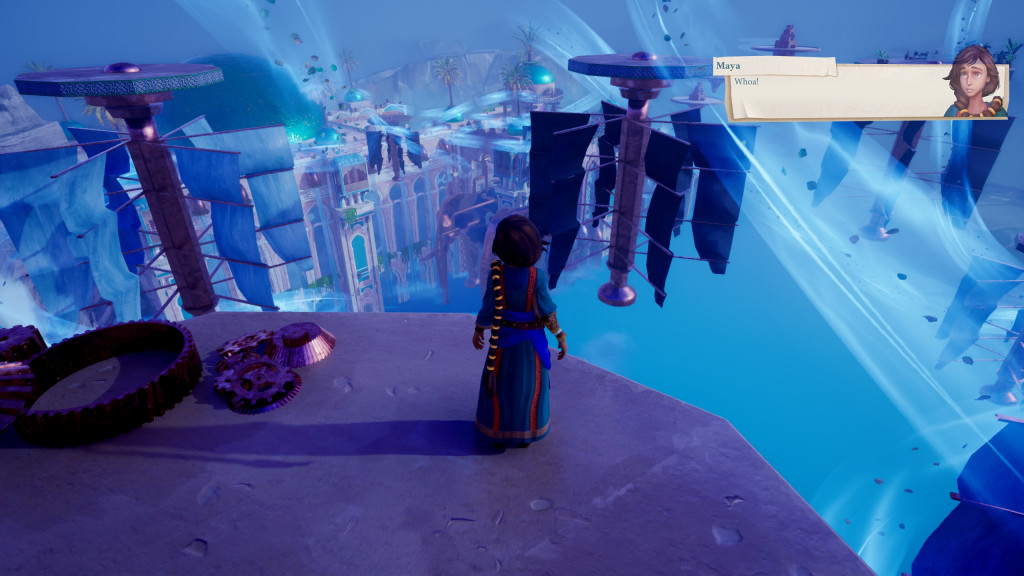
The character design is also delightful. I was so enraptured by each round, friend-shaped character that the utter lack of lip-sync animations never bothered me. Maya in particular has so many great details, from the physics of her long braided hair to the cloud of rose petals she leaves behind when she glides.
The soundtrack is also brilliant. All of the music was recorded live, using real Middle-Eastern/North African instruments including the rebab, oud, and simsimiyya. The result was well-worth the effort; every level is accompanied by beautiful, cascading strings that set a perfect atmosphere. They’re not songs that’ll get stuck in your head, but they capture a cultural aesthetic that greatly supports the story. The non-music sound design is solid too, especially the satisfying wooshes from whenever you use the Key.
I did run into a few frame-rate issues, but nothing extreme or long-lasting. While my rig is higher-end, I’m certain most any PC could run this game.
Longevity
The House of Hikmah is a short game. It took me around 5 hours to complete, and there isn’t much post-game content. It may be a short experience for the asking price, but it’s a well-paced, high-quality one.
Final Thoughts
Like a bowl of soup, The House of Hikmah is a satisfying blend greater than the sum of its parts. It takes a hearty stock of engaging story and builds upon it, with beautiful graphics, challenging puzzles, and atmospheric music. And while you may encounter occasional glitches, nothing should be too hard to swallow. In fact, it’ll likely leave you wanting a second helping.
I greatly enjoyed my time in The House of Hikmah and I believe you will too. I give it the Thumb Culture Gold Award and my personal recommendation.

Disclaimer: A code was received in order to write this review.
If you enjoyed this review, why not check out my previous review on The Coin Game!
YouTube | Facebook | Twitter | Instagram | Discord | Podcast
About Author