

Blades, Bows and Magic, developed and published by Funk Games, arrives on Steam with a smart little pitch. It takes the card battler formula, strips away most of the clutter, and builds the whole thing around placement, abilities, and a rock-paper-scissors core. Warriors beat Archers, Archers beat Mages, Mages beat Warriors. Simple. Clean. Easy.
That approach gives it an immediate charm, especially if you do not fancy wrestling with a hundred systems before the first fight. Nevertheless, that simplicity creates its own friction. Blades, Bows and Magic often let you understand exactly what should happen, but they do not always let you make it happen. The result is a card battler that feels approachable and lively, but also more random than strategic as the novelty wears off.
Blades, Bows and Magic need a sharpening and a few more spells
Before we get into it properly: Do you play card battlers for careful planning, or do you enjoy making the best of a slightly chaotic hand? Blades, Bows and Magic leans very heavily towards the second option, so we would love to know where you land on that.
Gameplay
You start with two Warrior cards, Mage cards, Archer cards, one Champion, and no Specials. Giving a good introduction without burying you in nonsense. There is multiplayer there from the start if you want to jump straight in, but the single-player campaign does a better job of showing what the game actually is. Each battle uses a rock-paper-scissors structure. That clarity helps a lot because it means the friction does not come from confusion. It comes from the fact that you only get one redraw, and after that, you work with what the game hands you. When your hand lines up nicely, Blades, Bows and Magic feel sharp. You place your units, watch it play out, and enjoy that brief moment of tactical smugness. When your draw doesn’t cooperate, though, it starts to feel slippery. That gap between knowledge and control defines the whole experience.
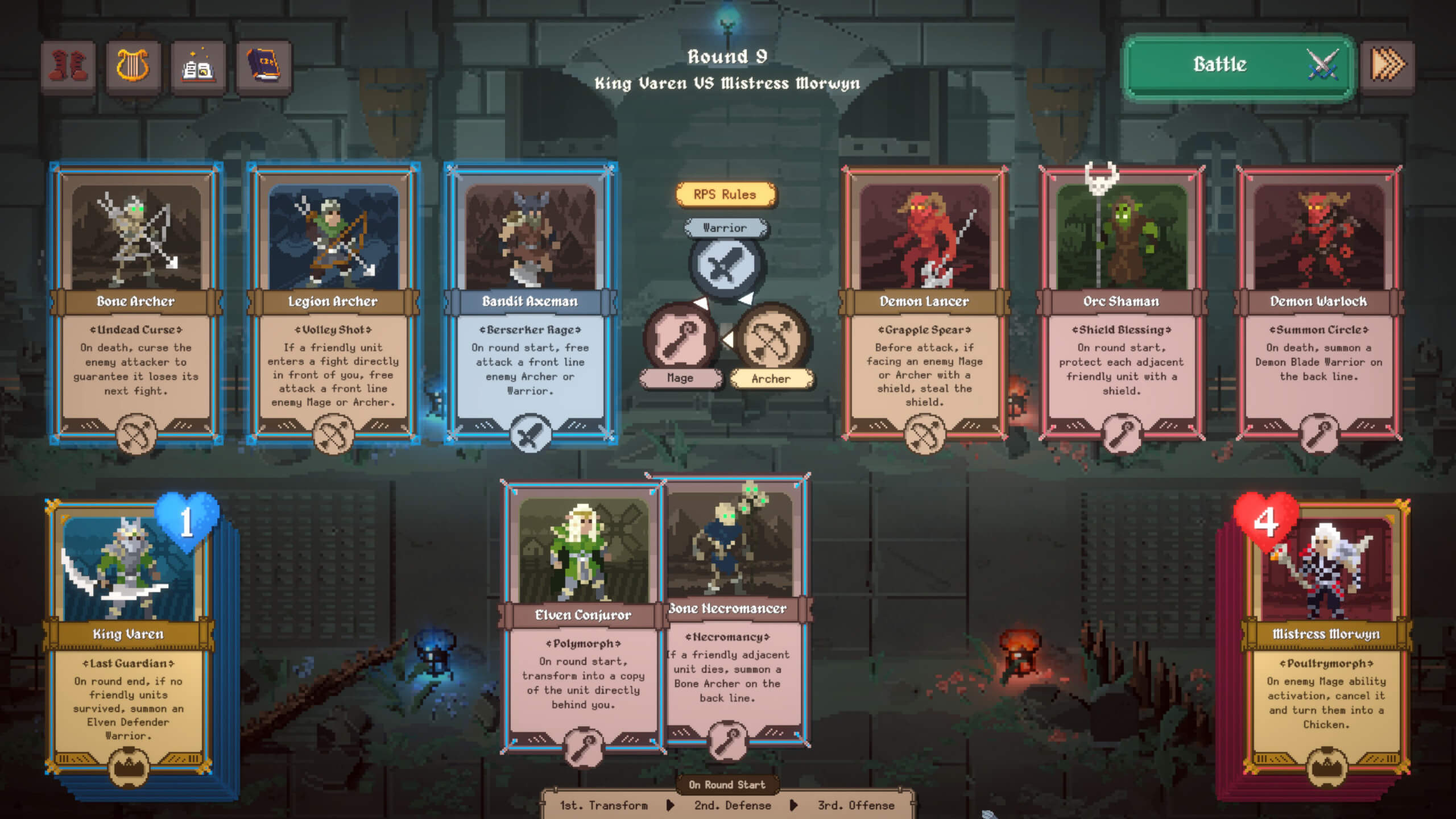
.Blades, Bows and Magic gives individual cards their own tricks, and those tricks often carry more personality than the core rules themselves. The Demon Blade, for example, can possess a Mage if a Mage kills it. That is the sort of ability that turns a straightforward exchange into a rude surprise. The Bone Archer cursing its attacker so it loses the next fight works in much the same way. These are not huge, sprawling mechanics, but they give battles a sly streak that keeps them interesting. Blades, Bows and Magic does not lock classes obvious roles. Instead, it lets card abilities create the real texture. That choice gives Blades, Bows and Magic its strongest moments, because the interesting part rarely comes from the basic counter triangle. It comes from the little bits of treachery hiding inside it.
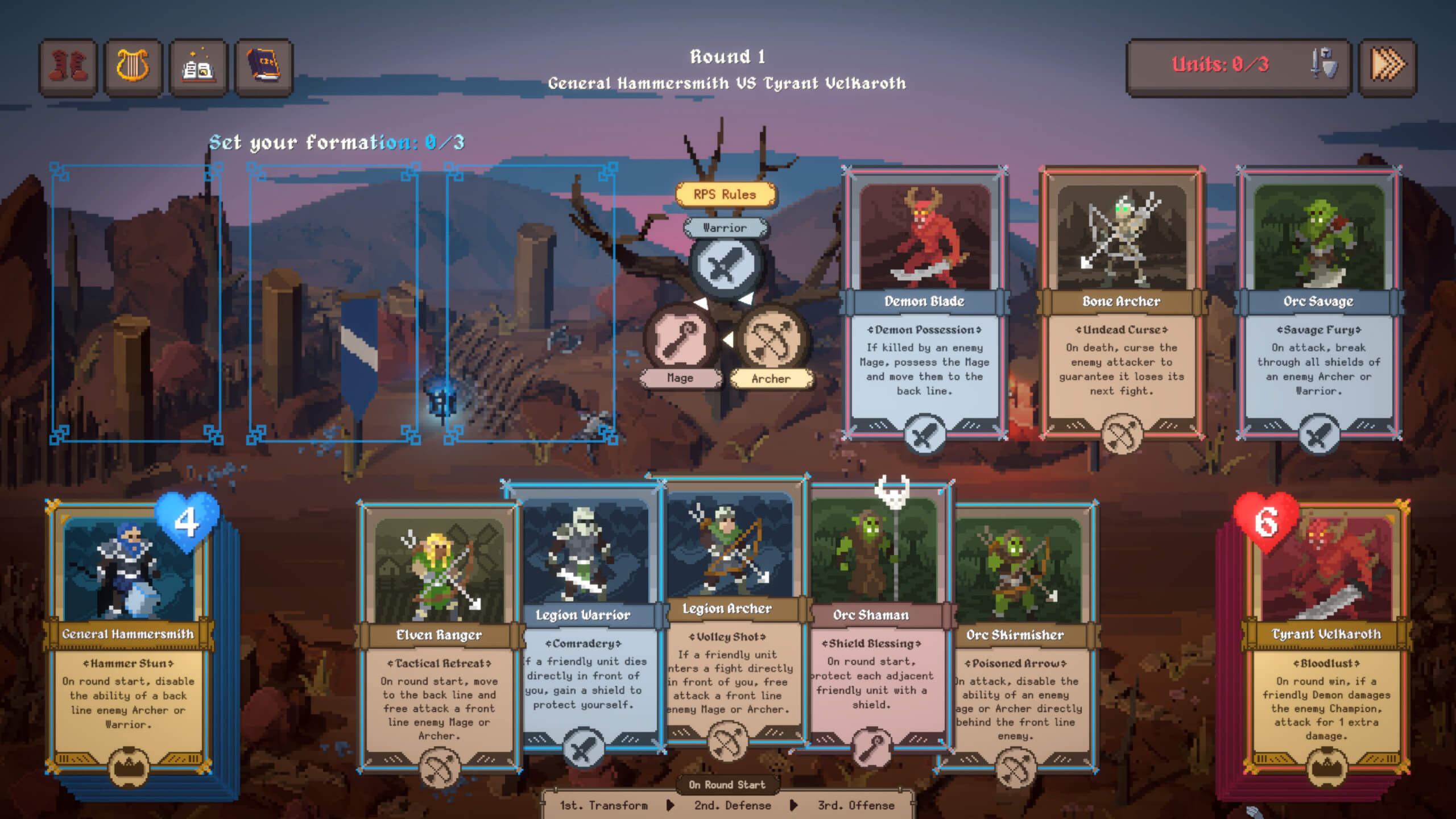
Blades, Bows and Magic has the deck battler part down, but not the deck builder part. You are not really crafting a build over time or shaping a strategy that feels yours fully. You are reacting. Improvising. Hoping the right tools appear at the right moment. Some players will enjoy that looseness. Others will miss the sense of control that usually makes card games so satisfying in the long run. It often feels like the game builds the plan, not the player. Should you lose, there is no restart of an entire run. You retry. Practice mode also feels undercooked. Right now, it only lets you replay the last battle you completed, just with whichever leader you want. A proper skirmish mode where you could choose the opponent, battlefield, and setup would give much more room to breathe.
Graphics and Audio
Blades, Bows, and Magic goes for a pixel-art style with a muted, slightly foggy tone. The colours are there, but they never shout. Greens, reds, snowy whites, and infernal pinks all come through, yet the whole game looks as if a faint mist hangs over it. Not striking, but consistent. It suits the game’s measured pace. The cards themselves have a nice bit of life to them. They bob gently in your hand, and each one moves during attacks rather than simply sliding about like cardboard with a grievance.
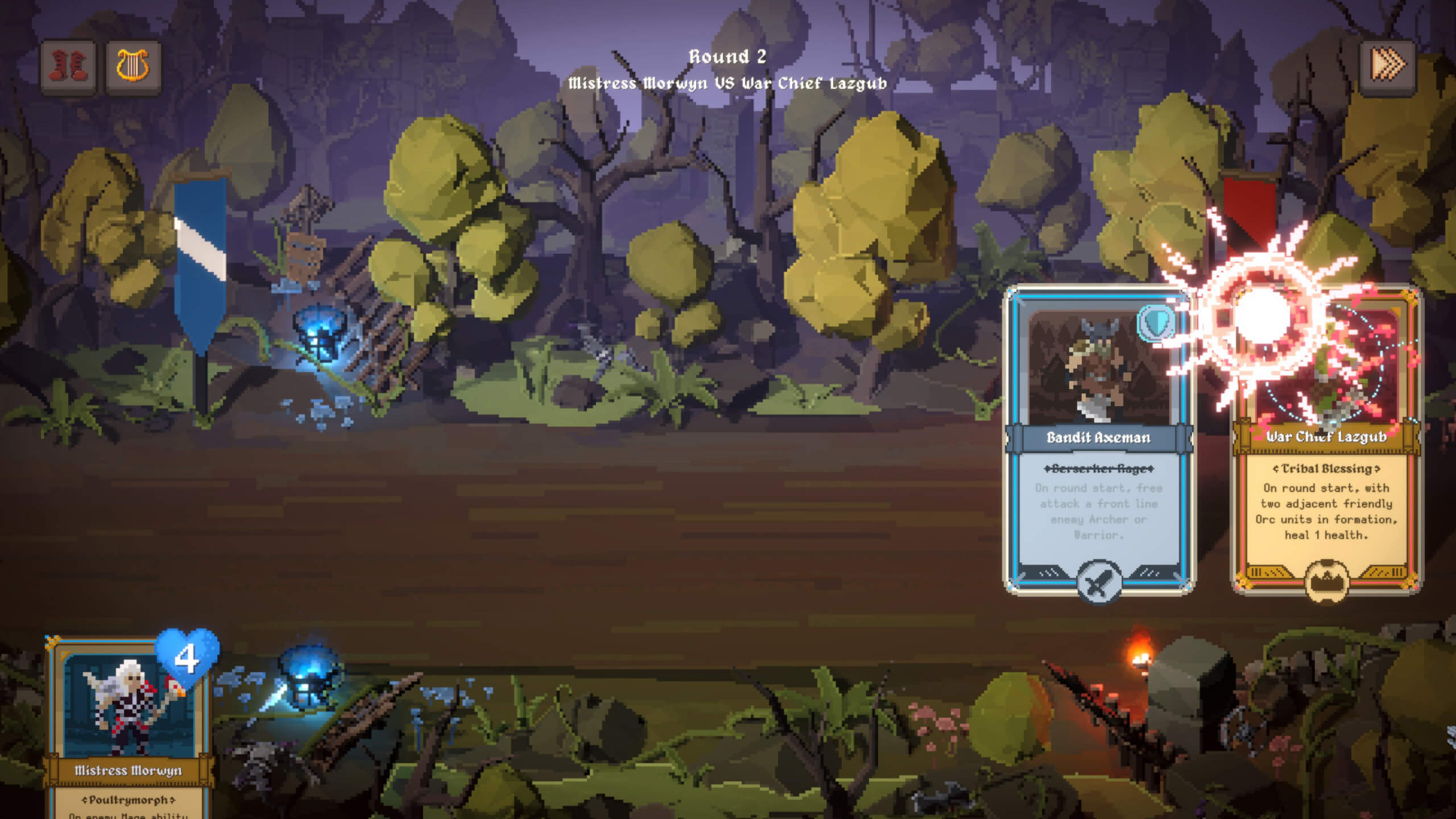
That small bit of animation helps more than you might expect. It keeps the battlefield from feeling static and adds a little energy to the clashes. The arenas do enough to break things up, even if most of them stick to fairly familiar medieval ground. Castle-like battlefields, snowy areas, and the occasional demonic backdrop stop the campaign from blending into one long brown blur. Spell effects and sword clashes are simple, but they do their job. Fireballs land with enough punch, and sparks from blades add just enough movement to keep your eyes engaged.
.The audio is a mixed bag. The little trumpet salute after a win is genuinely lovely and made me smile every time. Combat effects sound solid, too, with decent sword hits and magical blasts. The music, though, wears thin fast. The battle theme relies on slow hand-drum rhythms that repeat far too often, and after a while, it starts to flatten the mood rather than build it.
Longevity
This is a short game, and it feels like one. My run took around five hours, though I can easily see someone clearing it in less time. The bigger issue is not length alone. It is whether the game gives you enough control and variety to make another run feel meaningfully different. You can retry, but the campaign structure stays fairly rigid. You cannot redo fights in a way that encourages proper experimentation. Upon completion, you are looking to restart the campaign rather than refine a broader approach. Currently, that answer depends heavily on your tolerance for randomness. Not all Champions appear to be available yet; there are only a couple of Specials in the mix, and practice mode still feels thin. Multiplayer adds a little extra life, but the campaign itself does not offer a huge amount of strategic depth once you have seen its main tricks.
Final Thoughts
Blades, Bows and Magic is a simple card battler that understands how to make a small ruleset feel readable and occasionally clever. Its best card abilities create the kind of sneaky reversals that make you grin, and its straightforward design makes it very easy to pick up. On the Other hand, the lack of real deckbuilding leaves the whole thing feeling lighter than it should. You can read the board, spot the threat, and understand the counter, but you cannot always shape the outcome satisfactorily. That makes the strategy feel reactive rather than authored. Still, there is something quietly likeable about it. Not flashy, not especially rich, but tidy, mischievous, and easy to grasp. Blades, Bows and Magic know exactly what sort of game it wants to be. It just does not always give the player enough say.
Blades, Bows and Magic gets the Thumb Culture Silver Award.

Disclaimer: A code was received in order to write this review.
YouTube | Facebook | Twitter | Instagram | Discord | Podcast
About Author
