


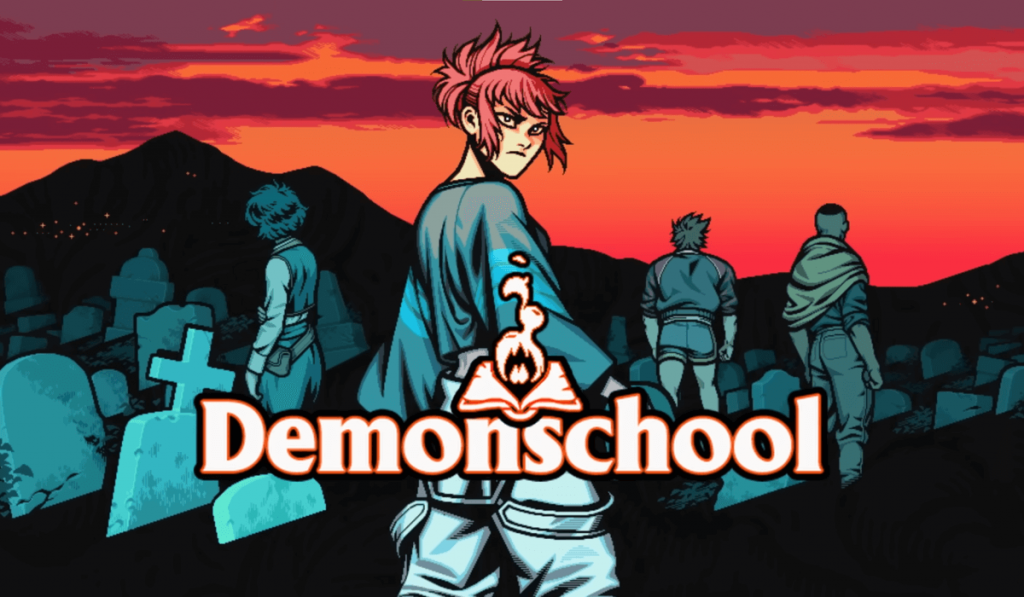
Demonschool first caught my attention and jumped onto my wishlist in June 2023, when it appeared on the Guerrilla Collective showcase. Back then it was slated for a 2023 release, which later became late 2024, and then late 2025.
Well, Necrosoft Games have finished their development ritual, and Demonschool launched on 19th November. It’s available on PS4, PS5, Xbox One & Series X|S, Nintendo Switch, and Steam. Prices vary by store, up to £19.99, but there’re introductory discounts into early December.


School’s Out, Demons Are In
Faye is an overexcited demon hunter on her way to college on the island of Hensk. She’s sure, thanks to an ancient prophecy, that demons, and the apocalypse, are coming to the island. Immediately upon arrival at the island, things become more complicated as gangsters appear to be classifying and separating students, professors are acting strangely, and people are losing their memories. As she works to understand a prophecy passed down to her, she’ll meet friends, enemies, and frenemies, and will need all the help she can get.
Gameplay
Demonschool’s gameplay is essentially broken down into 2 phases; exploration and battles. In the former, you’ll be navigating numerous static environments and interacting with various points of interest. In the latter you’ll be engaged in a simplified, tactics battle system. Both of these combine to create the core DNA of Demonschool. I’ve enjoyed this cycle of story progression and puzzle-like combat, despite a few hiccups along the way.
Tactical Combat
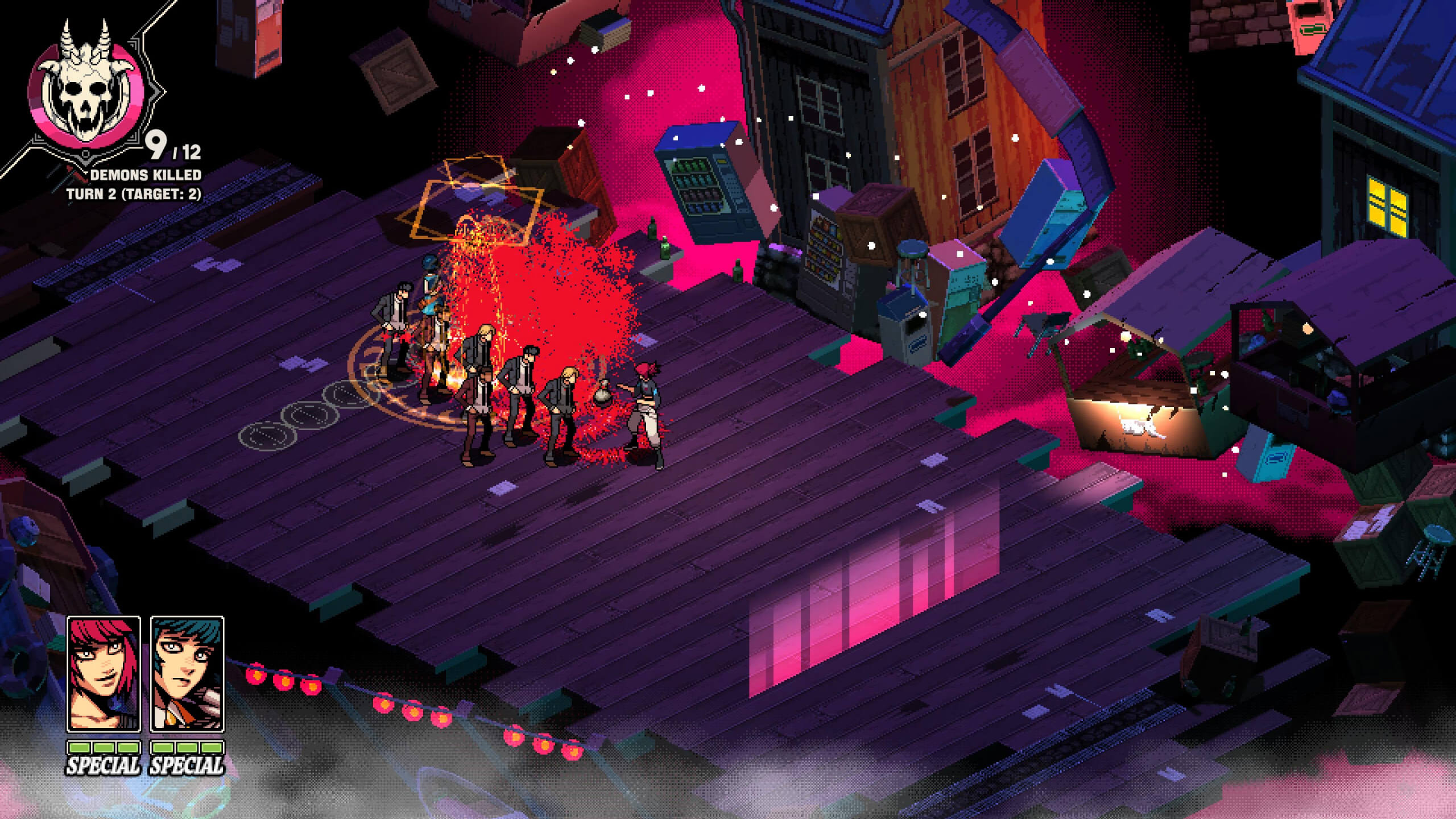
Let’s begin by talking about the most engaging system in Demonschool, the tactical battles. These mostly take place on a long, narrow, isometric grid. Up-to 4 characters from your team are positioned at one end, and enemies are spawned between them and the opposite end of the grid. In order to win, you must defeat a certain number of enemies and reach the opposite side. Perform well — complete the battle in a specific number of Turns and don’t have any characters die — and you’ll earn more Class Credits.
Battles occur in Turns, and Turns have a Planning Phase and an Action Phase. While planning you have the complete freedom to test out combinations of moves, attacks, and specials, and see how they will affect the Turn. You can undo each action you take, in sequence, and adjust your tactics until you’ve decided on your best approach. Then, the magic happens. After you’ve confirmed your Planning Phase, the Action Phase begins and you characters make their moves. It’s amazing how the game analyses the options you’ve picked, and forms them into a cohesive, fluid round of combat. It’s easily my favourite part of Demonschool’s design.

Unlike other tactics games I’ve played, Demonschool doesn’t give characters multiple attack options. Instead, each character has an attack and a special, and they can move in straight lines around the grid. Different classes of characters have different effects for their attack. For example, main character Faye’s attack will deal damage and knock an enemy back 1 tile by default. Namako, however, will pass through an enemy, and all enemies in that line if they’re in adjacent tiles, lowering their defence and leaving them stunned. Combining these characters and they’re attack effects will be essential in completing battles quickly and efficiently.
Skill Tree
While the battle system is simplified, you can still customise characters for battles. Class Credits earned in fights, and in the weekly school quizzes, can be used to learn new abilities. These can then be applied to certain characters to enhance their capabilities. Maybe you want to add poison to an attack, or increase the number of tiles an enemy is pushed back, or gain the ability to pass through enemies who are separated by a tile. There’s loads of room for tweaking your build and affecting how you approach different battle scenarios. In total there’re 66 unlockable skills, and each character can equip a total of 3 skills, giving you plenty of options.
Skills become available to be studied by characters when they are unlocked via quests and relationships, or bought in the shop. Once unlocked, you’ll need to assign several characters to study them, which costs Opals (earnt in battles or found during activities) and time. The skill will then become available to equip immediately, but the characters who studied it will need to wait a set number of days until they can study again. This makes unlocking skills a little slow in the beginning, but by the mid-game, when you have a dozen teammates, you’ll have more skills than you know what to do with.
11 Weeks To Save The World
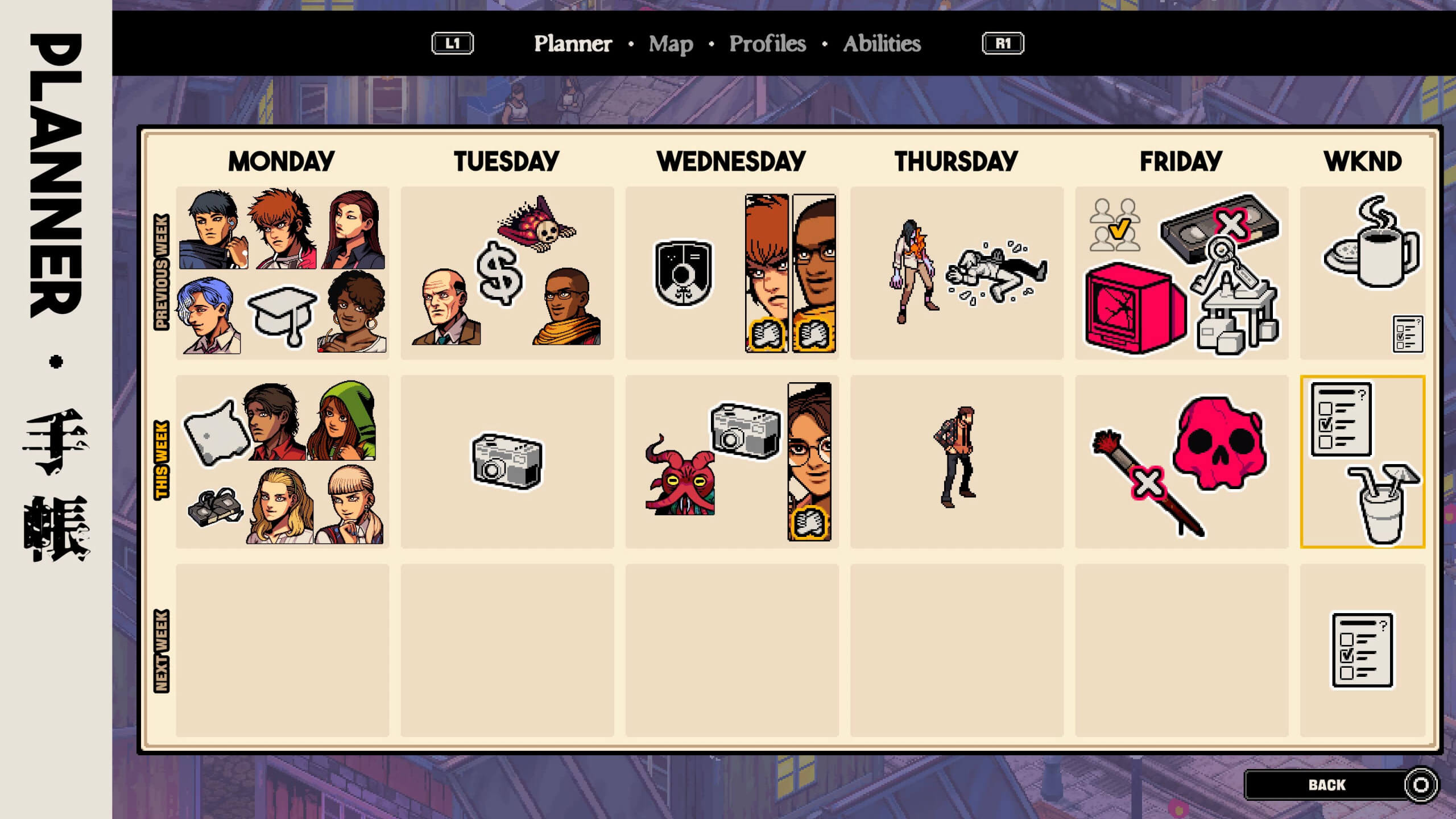
When you’re not killing demons and sealing portals, there’s a whole island to wander round and explore. Each day of the week is broken down into 3 segments; morning, evening and night. In each of these, you’ll have a main quest marker that you can interact with to advance both the story and time. Away from the main path, there’re various activities and side-quests to keep you busy. The best part about the way Demonschool implements its calendar system is that these additional and optional activities don’t cost you time. This means there’s no pressure on you to manage your time and stress about what to focus on; you can get to everything.
Relationships with other characters can be improved by taking part in paired activities around the island, such as karaoke and cooking. These mini-games, if played successfully, will increase your relationship level with a character, and unlock special events at certain thresholds. Once you reach the max level of a relationship, you can choose a platonic or romantic ending. These are fairly light-touch though, and don’t really alter character interactions long-term. Alongside relationships, there’re recurring interactions that play out small side stories, such as a wishing well and a religious shrine, and reward you with currency, skills, or cosmetics if you continue them.
Side-quests appear semi-frequently and often have multiple stages to them, played of the course of a few days. These are usually small, contained stories the involve some dialogue options that can improve your relationships with characters and additional battles. Again, these don’t affect the passage of time, so you don’t have to worry about missing out on completion of other things by doing these.
Graphics & Audio
Demonschool is beautifully presented in a retro-inspired, isometric view. Each area you’ll visit and explore is lovingly detailed with pixel-art. There’s also a vast array of art for the characters that’s used to display them during conversations, with different emotions and expressions. My personal favourite is Mercy whenever she talks about her dog, Pocket. In fact, with so much character art, there’s even a mini-game that tests your knowledge of each characters poses. Sometimes, in the lead up to big boss battles, there’s a 3D camera that pans down and through the scene, showing off the big-bad and our 2D pixel-art characters facing up to them. These were always really cool moments.
The soundtrack is catchy and atmospheric, with creepy, 70s synths, inspired by old Italian horror films. A few tracks are stuck in my head, and I don’t mind. Building out the sound of Demonschool are a series of sound effects that add to the odd horror vibes. There’s a sound best described as ‘wobbly’ that happens when players are shocked, surprised, or creeped out, and a gushing, explosive burst when demons are killed, accompanied by a fountain of blood, that combine with the music and aesthetics to create this grungy, 90s setting.
Longevity
It’s easy to see why this game took so long to polish and complete, it’s not small or short by any stretch. At about 2/3rds completion, I’m up to almost 30 hours played. I’ve been doing all the optional side-questing and activities along the way, so if I was just focusing on the main story, that might drop down to 20. Either way, there’s lots to see and do in Demonschool and I don’t think you’ll be disappointed in its length. On the replayability front, there’s no branching paths, so it will be the same game, but its been enjoyable enough that I could see myself doing another playthrough in a few years.

Final Thoughts
Demonschool is a refreshing take on the tactics RPG genre. Simplifying the battle system and giving players the ability to plan and adjust each turn in combat provides a fun and engaging puzzle element to battles that had me tinkering and tweaking my team selection and tactics to find the most efficient solutions to each fight. Unfortunately, playing the pre-launch build led to a few bugs and hiccups along the way, but thankfully, nothing that rendered the game unplayable. Necrosoft have released patches, including a day one patch that updated the in-game font and confused me for a moment, and are continuing to bug fix. Hopefully the bugged PlayStation trophy is fixed in the next patch and people can get their Platinum.
If you’re a fan of old-school tactics RPGs and want something a little bit different, but cut from the same cloth, join Faye and the gang in trying to prevent an apocalypse.
Demonschool gets a Thumb Culture Gold Award.


Disclaimer: A code was received in order to write this review.
Looking for more pixel-art tactics RPGs? Check out Kevin’s preview of Live By The Sword: Tactics here.


YouTube | Facebook | Twitter | Instagram | Discord | Podcast