



“And the Lord Of All Games spake, ‘Thou shalt not make a game in the image of a data entry overtime shift’, and all saw and said it was good.” -Polygonics 4:51


Angel Engine is a self-proclaimed “horror surgery simulator” developed by HMS Studios and Black Lantern Collective and published by NerveLabs and Aurakenn Games. It is currently only available for PC.
Clocking In to the Martyr Factory
The game is based on a highly-popular short-form analogue horror series of the same name, centered around humanity kidnapping an angel and performing horrific experiments on it it to try and stave off Armaggedon. Based on my research, the original Angel Engine series is controversial for heavy AI usage, to the point that the Steam page directly says that, unlike the original, this game doesn’t use any AI. And after playing it myself, I can say that it doesn’t. Angel Engine‘s issues are deeper and more complex than simple AI art.
But I’ll get to its flaws in due time. Like all of humanity, Angel Engine is a blend of good and bad. I don’t intend to send it to purgatory without first applying proper judgement.
Gameplay
Angel Engine falls into a subcategory of horror game that I like to call “routine horror“, following in the footsteps of its pizza-loving pioneer, Five Nights at Freddy’s. These games have some sort of relatively simple core gameplay loop (i.e. checking cameras, closing doors), but steadily add in new, contradictory mechanics that make completing your objectives more and more difficult. And if you fail, well-

In Angel Engine‘s case, the core gameplay loop is an operation. You use WASD to maneuvere a device over the glowing technicolor wounds on your “patient’s” body, then select the corresponding tool and complete a short minigame to cure(?) it. Complete a certain number of wounds on a certain number of bodies, and you win! However, your time is limited. Your patients will steadily wake up, and while you can administer anaesthetics to calm them down, you can only buy time for so long. You’ll also need to keep your station’s power levels up, by turning around and playing a short Flappy Bird-style minigame.
As you progress, more spinning plates are thrown out for you to balance. Corpses will gain the ability to mess with your equipment in different ways, such as shorting out power systems, reversing your controls, and even cutting the lights. You can use a vial of holy water to guard devices against the next attack, but this only works on one device at a time. You can also just fix the issue, but that’s time spent fiddling with fuses that you could spend on treating wounds. If you don’t maintain constant vigilance, it’s extremely easy to get caught in a doom spiral of problems you simply don’t have the time to fix.
The Issues
And therein lies the main flaws with Angel Engine‘s gameplay: the sheer glut of competing systems. To be fair, it does an excellent job of teaching you individual mechanics through short puzzles in neat post-operation vignettes. But actually combining all of those mechanics together makes for a frustrating and not particularly fun experience. There’s also a ton of RNG: some games, like the claw minigame, can either be finished in a few seconds or require a non-negligible amount of waiting, depending on what type of layout spawns. Not to mention sometimes multiple devices can be attacked at the exact same time, leaving you simply unable to avoid a lengthy repair process.
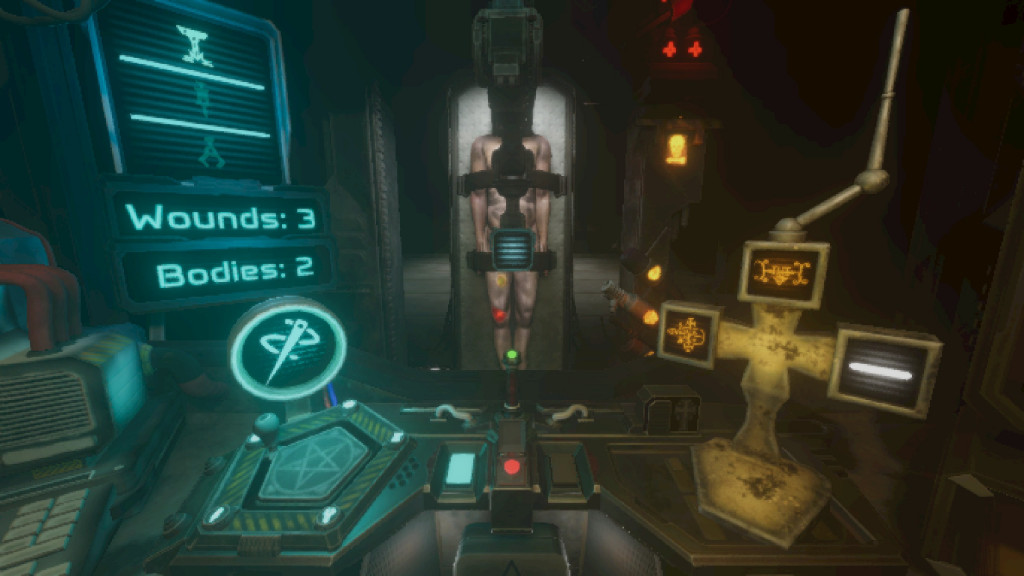
I was able to push through most of the game before hitting a wall on the penultimate operation. 7 corpses, each one covered with wounds that require upwards of 10 minigames in total to cure, all while dealing with constant interruptions and holy water jangling. I tried my best to push through, but after a solid half-hour of attempts I was too exhausted to continue. Not because I couldn’t do it- I’d become a crack shot with my holy water and learned how to minmax the power minigame in between operations- but because I just wasn’t having fun. It didn’t feel like a nail-biting horror rollarcoaster. It felt like a bad shift at work.
Narrative
Speaking of work, that’s about all the story of Angel Engine really entails. You play as an unnamed intern and recent hire to the Babel 2 facility, where you do your work on corpses… and that’s about it, really. The only other character you encounter is a security guard who peeks into your room after every operation. He either talks about a vending machine or waxes philosophic about the nature of man’s predisposition to violence.

You can also read emails on your computer that, ostensibly, provide hints towards the dark secrets Babel 2 is hiding. Unfortunately, the game gives zero context as to the identities of the writers and what they’re talking about. Perhaps it would make more sense to people familiar with the analogue horror series, but I just felt bombarded by long, vaguely-ominous paragraphs about stuff that didn’t make any sense.
Graphics
Where Angel Engine really shines is in its presentation. The game does a lot with its low fidelity, and crafts an eerie, atmospheric office area dripping with religious-horror aesthetics. Hell, the two major tools you use when operating are shaped like a cross and a pentagram! It isn’t hyperrealistic, and the human models are pretty average, but the solid design principles and unique aesthetic more than make up for it. The game also does a good job of providing visual clarity for your tasks, such as making all of the wounds bright colors to stand out against the otherwise-muted brown color palette. Sometimes wounds around the neck area would be harder to make out, but otherwise I had no major issues knowing what to do next.

Audio
The sound design is decent, if a little disjointed. Most of the time the only sound you hear is the ambient groaning and grinding of the machinery around you. But the music (bass-thumping industrial techno) seemed to just kick on and off and random later in the game. Up to that point music only played in dangerous situations, such as when a patient was about to wake up, so it was quite jarring.
On the whole, I generally preferred the lack of music, since let me concentrate better on hearing the sound cues. Sound is vital to succeeding in Angel Engine, as sounds play to alert you when a device is about to be attacked. When you’re buried in a minigame you can’t see the visual indicator on your dashboard, so that sound cue is often the only thing giving you time to defend yourself. I’ll be frank: this game isn’t possible to play without volume.
On one last note, I’ll briefly talk about the jumpscares. They’re the same as other routine horror game- fail to keep your plates spinning, and and something screams at you. I’ll be honest, though, outside of the first jump Angel Engine’s scares never really got to me. I think the main issue is that the occur they instant you run out of power or anesthesia, which isn’t something that just happens out of the blue. The sound cues and predictable jump mean you can see the scares coming from a mile away. Compare Five Nights at Freddy’s, which lets you stew in the dark for a while before Freddy loudly comes a’callin.
I never encountered any major graphical or gameplay issues, and my framerate was steady. I don’t think this is a very labour-intensive game to run.
Longevity
Even with its difficulty curve, at most Angel Engine takes just 2 to 3 hours to complete. It’s even shorter if you know what you’re doing. There is some post-credits content, but not nearly enough to really justify a replay.
Final Thoughts
And so, Angel Engine‘s life draws to a shockingly quick close. But what will be its eternal reward?
On the side of virtue, Angel Engine has solid visual and audio presentation and does a great job of introducing mechanics without overexplaining them. On the side of vice, it features a gameplay loop that is more frustrating than frightening, and a confusing, vague narrative that talks horror at you without letting you experience it. And while the time I spent with it was brief, I don’t really find myself craving more.
So I, The Lord Of All Video Games For Time And Eternity, deliver final judgement. For being a competently made, but not particularly exciting or frightening game, Angel Engine shall spend the rest of eternity in a Nantucket dive bar, where the water is a little too warm and the grilled cheese is a little too cold. And so the Lord spake, and it was good.
In all seriousness, I’d recommend Angel Engine if you’re a superfan of the series. Otherwise, I’d suggest waiting for a sale.


Disclaimer: A code was received in order to write this review.
If you enjoyed this review, why not check out this review of Inky Blinky Blob!



YouTube | Facebook | Twitter | Instagram | Discord | Podcast